Short answer: on an NNN industrial lease, the tenant pays the property taxes, the insurance and the common area costs on top of base rent, but that does not automatically make the tenant responsible for the roof or other big repairs. Who repairs and who replaces the roof, the structure and slab, the HVAC, the dock doors and the parking lot is set in the repair and maintenance section of the lease, and it is negotiated deal by deal. Read that section, and how capital costs are passed through, before you trust the rent.
A lease can say triple net and the landlord can still end up paying for a new roof. I see this come up all the time with warehouse buyers in Miami-Dade, Broward and Palm Beach. The rent looks clean, the lease says NNN, and everybody assumes the tenant covers everything. Then a big repair shows up and the lease says something different.
What NNN actually covers
NNN, or triple net, means the tenant pays three things on top of base rent: the property taxes, the building insurance and the common area costs. That part is pretty standard from one lease to the next.
What NNN does not settle on its own is who pays to repair or replace the big pieces of the building. That is a separate question. It lives in the repair and maintenance section of the lease, and that section can look very different from one deal to the next, even when both leases are called NNN. I compare the main lease types in NNN vs gross vs modified gross leases, and the same labels show up on industrial deals.
Repair vs replacement: the difference that matters most
A lot of leases split the work into two buckets. Repairs and maintenance are the ongoing work that keeps the building running, like fixing a leak or servicing a unit. Replacement is the big ticket item at the end of something's life, like a new roof or a new HVAC system.
It is common for a tenant to take on repairs while the landlord keeps replacement, or for the two to share it in some way. So the question is never just "does the tenant pay for the roof." It is "does the tenant pay to fix the roof, to replace the roof, or both."
The five lines I read on every industrial lease
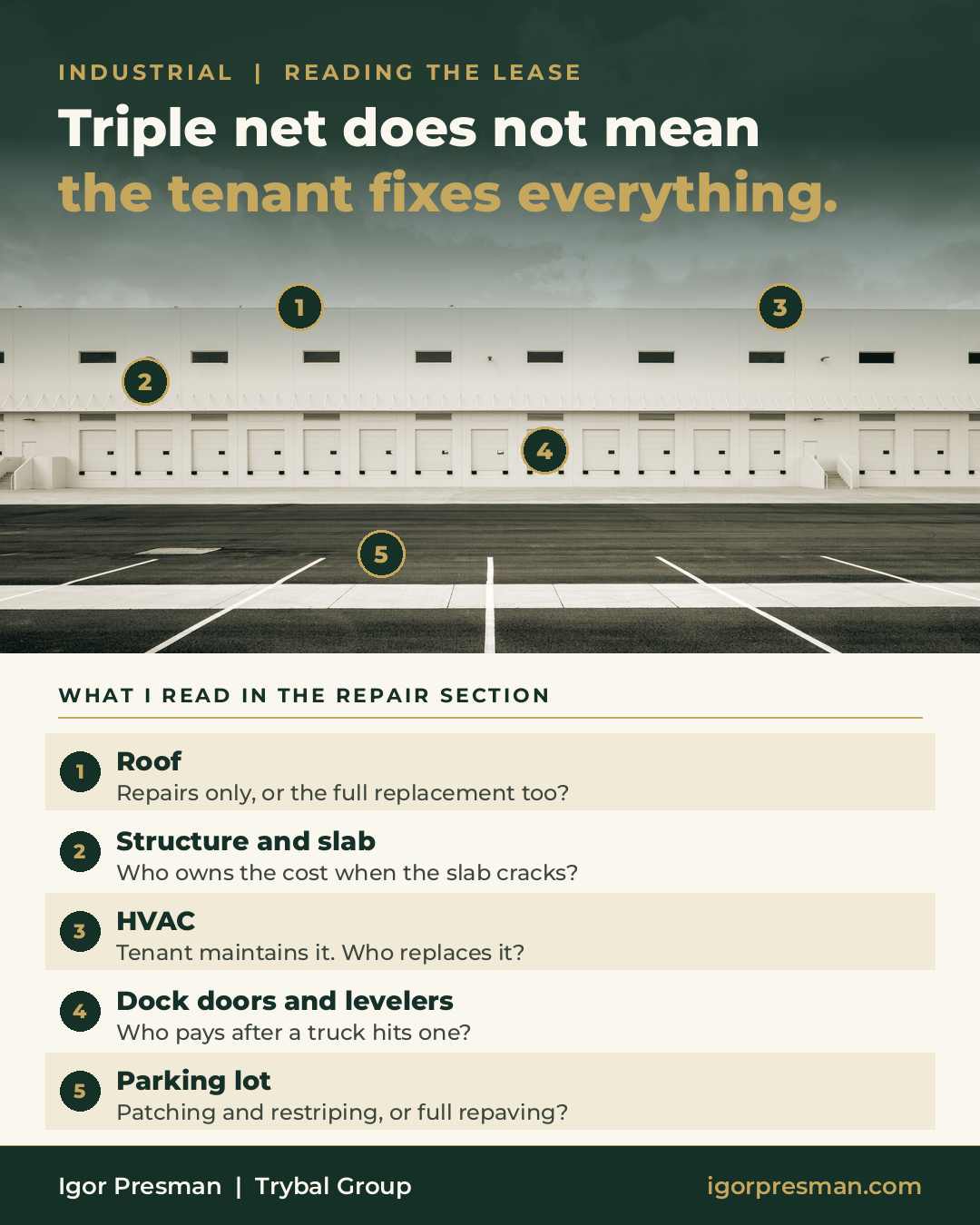
These are the lines I read on every industrial lease before I tell a client what the net really means.
The roof
Is the tenant only responsible for repairs and leaks, or for the full replacement when the roof reaches the end of its life? In South Florida, with our sun and our storms, this one matters. I also look at whether a roof warranty exists and who has the right to deal with the roofer.
Structure and slab
Walls, columns, the foundation and the floor slab. Who owns the cost if something structural goes wrong? Many leases keep structure with the landlord, but not all of them, and on a single tenant building the language can push more of it onto the tenant.
HVAC
A lot of leases have the tenant maintain the units and keep a service contract. Replacing a unit is a much bigger number, so I want to know who pays for that, and whether the tenant has to prove the service contract was kept up.
Dock doors and levelers
In a working warehouse, trucks hit doors. Is that ordinary wear, tenant damage, or a landlord repair? The answer decides who gets the bill every time a driver misjudges a turn.
The parking lot and truck court
Patching and restriping is routine. Repaving the whole lot is a capital project. On an industrial site with heavy trucks, the truck court takes a beating, so I look at who handles each level of work.
How capital costs get passed through
After those five lines, I look at how capital costs are handled overall:
- Can the landlord pass capital costs through to the tenant at all?
- If so, are they spread out over the useful life of the item instead of billed all at once?
- Is there a cap on what the tenant pays toward them each year?
- Are there exclusions, like costs from the original construction or from the landlord's own negligence?
Two leases can both say NNN and still split a new roof in completely different ways depending on how this language is written.
What this means for buyers
For a buyer, this changes the math. Two warehouses at the same rent can cost the owner very different money over a ten year hold. If the landlord keeps roof replacement and the roof is near the end of its life, that cost is effectively yours the day you close. I pair this with what I look for in the building itself in what I check on every warehouse tour in South Florida, and with the tenant side in what makes a warehouse tenant creditworthy. A tenant who is on the hook for a big repair only helps you if they can actually pay for it.
What this means for tenants
For a tenant, it changes what the space really costs you every month. A lower base rent with full repair and replacement responsibility can end up costing more than a slightly higher rent where the landlord keeps the roof and structure. Read the repair section before you compare two spaces on rent alone, and have your attorney review the language.
FAQ
Q: Does an NNN lease mean the tenant pays for the roof?
Not automatically. NNN means the tenant pays taxes, insurance and common area costs. Who repairs or replaces the roof is set in the repair and maintenance section of the lease.
Q: What is the difference between roof repair and roof replacement in a lease?
Repair is ongoing work like fixing leaks. Replacement is installing a new roof at the end of its life. Many leases assign them to different parties.
Q: Who usually pays for structural repairs on an industrial lease?
It depends on the lease. Many keep structure and slab with the landlord, but some, especially on single tenant buildings, shift more of it to the tenant.
Q: Can a landlord pass capital costs through to a tenant?
Sometimes. The lease decides whether capital costs can be passed through, whether they are spread out over the useful life, and whether there is a yearly cap.
Q: Why does this matter when buying a warehouse?
Two warehouses at the same rent can cost the owner very different money over a hold, depending on who pays for the roof, structure, HVAC, dock doors and parking lot.
If you are buying, selling or leasing industrial space in Miami-Dade, Broward or Palm Beach, I am happy to walk through a lease with you. Reach out to me directly, browse my current listings, or ask about off-market opportunities.

Igor Presman
Commercial Broker · Trybal Group