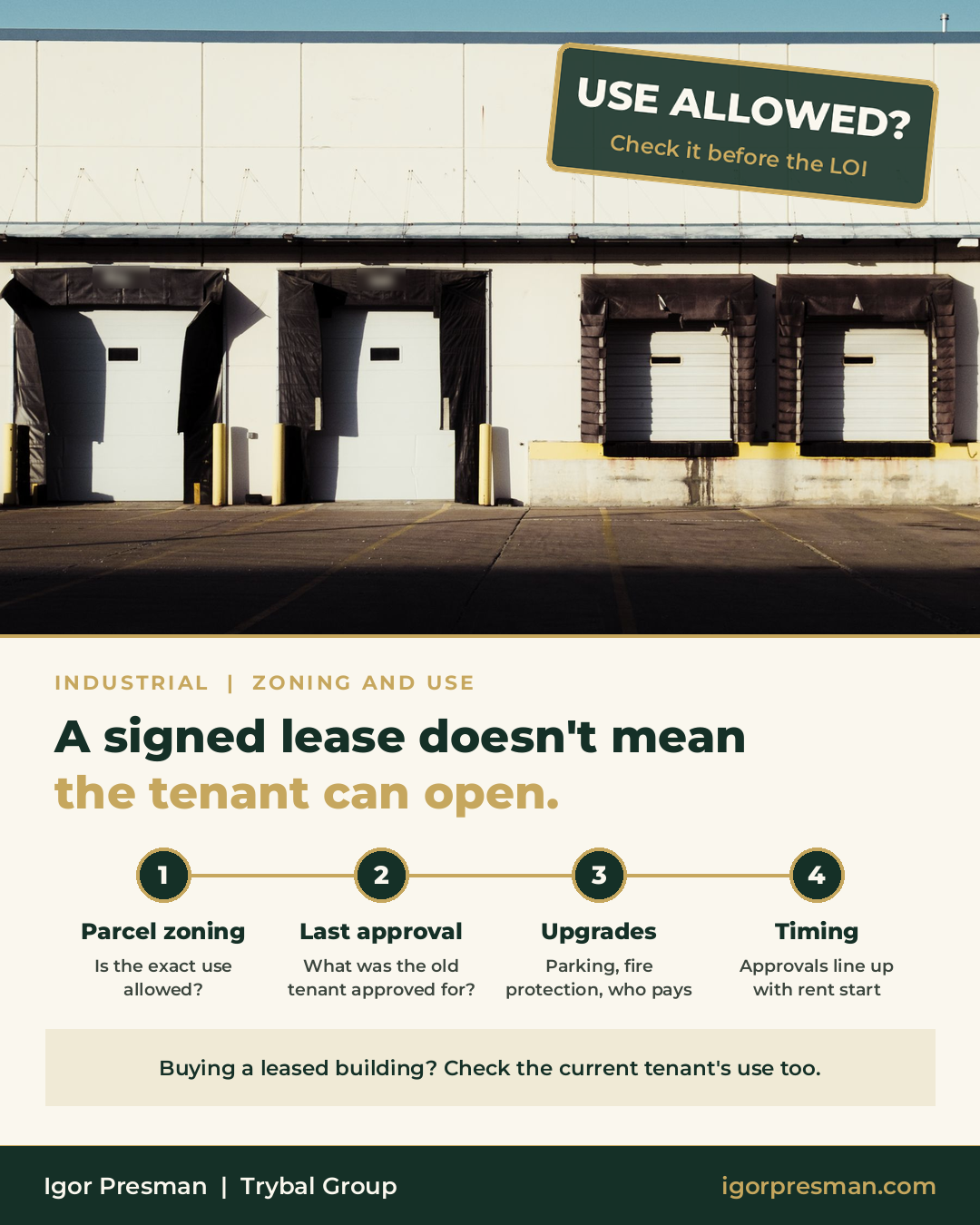
Short answer: a signed lease does not mean the tenant can open. Before a warehouse tenant can operate in Miami-Dade, Broward or Palm Beach, the city or county has to be fine with the use. That usually means checking the zoning on the parcel, and depending on the jurisdiction, getting a certificate of use and a local business tax receipt. I check the use before an LOI goes out, not after the lease is drafted.
This is one of the most overlooked steps in industrial leasing. Landlord and tenant agree on rent, term and the build-out. The lawyers draft the lease. Then the tenant goes to the city for its approvals and finds out its business is not allowed in that building. By then, everyone has already spent time and money.
Zoning is about the use, not just the building
Every parcel has a zoning designation. That zoning lists which uses are allowed by right, which need a special approval, and which are not allowed at all. Two warehouses on the same street can sit under different zoning, so you cannot assume the building next door tells you anything about the one you are looking at.
A building that has been a warehouse for twenty years can still block a new use. Storage is not the same as auto repair. A dry warehouse is not the same as a commissary kitchen. The structure can look right and the zoning can still say no.
Certificate of use and local business tax receipt
Depending on the city or county, the tenant may also need a certificate of use and a local business tax receipt before it can open the doors. Zoning answers whether the use is allowed on the land. The certificate of use confirms that this specific business is cleared to operate in that space. The local business tax receipt is the local license to do business.
If any of those are missing or denied, the tenant cannot legally open, even with a signed lease and keys in hand.
Uses that tend to raise questions
The uses that tend to raise questions are the ones you would expect:
- Auto repair and car storage
- Food prep and commissary kitchens
- Outdoor storage
- Light manufacturing
- Anything that handles chemicals or creates noise and fumes
None of these are automatically blocked everywhere. Some are allowed by right in the right zone. Some need a special exception or a conditional use. Some are not allowed on that parcel at all. The only way to know is to check the parcel, not the neighborhood.
What I check before an LOI goes out
Here is what I look at before an LOI goes out, not after the lease is drafted:
- The zoning on the parcel, and whether the tenant's exact use is allowed, allowed with conditions, or not allowed.
- What the last tenant was approved for. A similar use is usually a smoother path than a big change.
- Whether the new use could trigger upgrades, like more parking, fire protection or other building work, and who pays for them.
- How long the approvals could take, so rent start and the tenant's opening date line up.
Catching this early saves everyone time. It is also part of how I match the right tenant to the right building. I pair this with the physical walkthrough in what I check on every warehouse tour in South Florida, and with how the lease splits big repairs in who pays for the roof on an NNN industrial lease.
If you are buying a leased building
For investors buying a building that is already leased, the same check applies to the tenant in place. If their use was never properly approved, that is a risk you would be buying along with the rent. Ask for proof of the approvals, and look at whether a change of use would be needed if that tenant left.
Development and land use sit next to this topic. If you are looking at ground up work rather than an existing warehouse, I cover entitlements and density in development and zoning in Miami-Dade.
FAQ
Q: Can a tenant open after signing a warehouse lease?
Not until the city or county clears the use. Zoning, a certificate of use and a local business tax receipt may all be required, depending on the jurisdiction.
Q: What is a certificate of use?
A certificate of use is a local approval that confirms a specific business is cleared to operate in a specific space. It is separate from the lease and from the zoning designation on the land.
Q: Why can two warehouses on the same street have different rules?
Each parcel has its own zoning designation. Neighboring buildings can sit in different zones, so one use can be fine next door and blocked on your building.
Q: When should you check zoning in an industrial lease deal?
Before the LOI goes out. Waiting until after the lease is drafted is when deals stall and everyone has already spent time and money.
Q: Why does this matter if you are buying a leased warehouse?
If the tenant in place was never properly approved for their use, you are buying that risk along with the rent. Ask for the approvals before you close.
If you are leasing, buying or selling industrial in Miami-Dade, Broward or Palm Beach, reach out to me directly, browse my current listings, or ask about off-market opportunities.

Igor Presman
Commercial Broker · Trybal Group