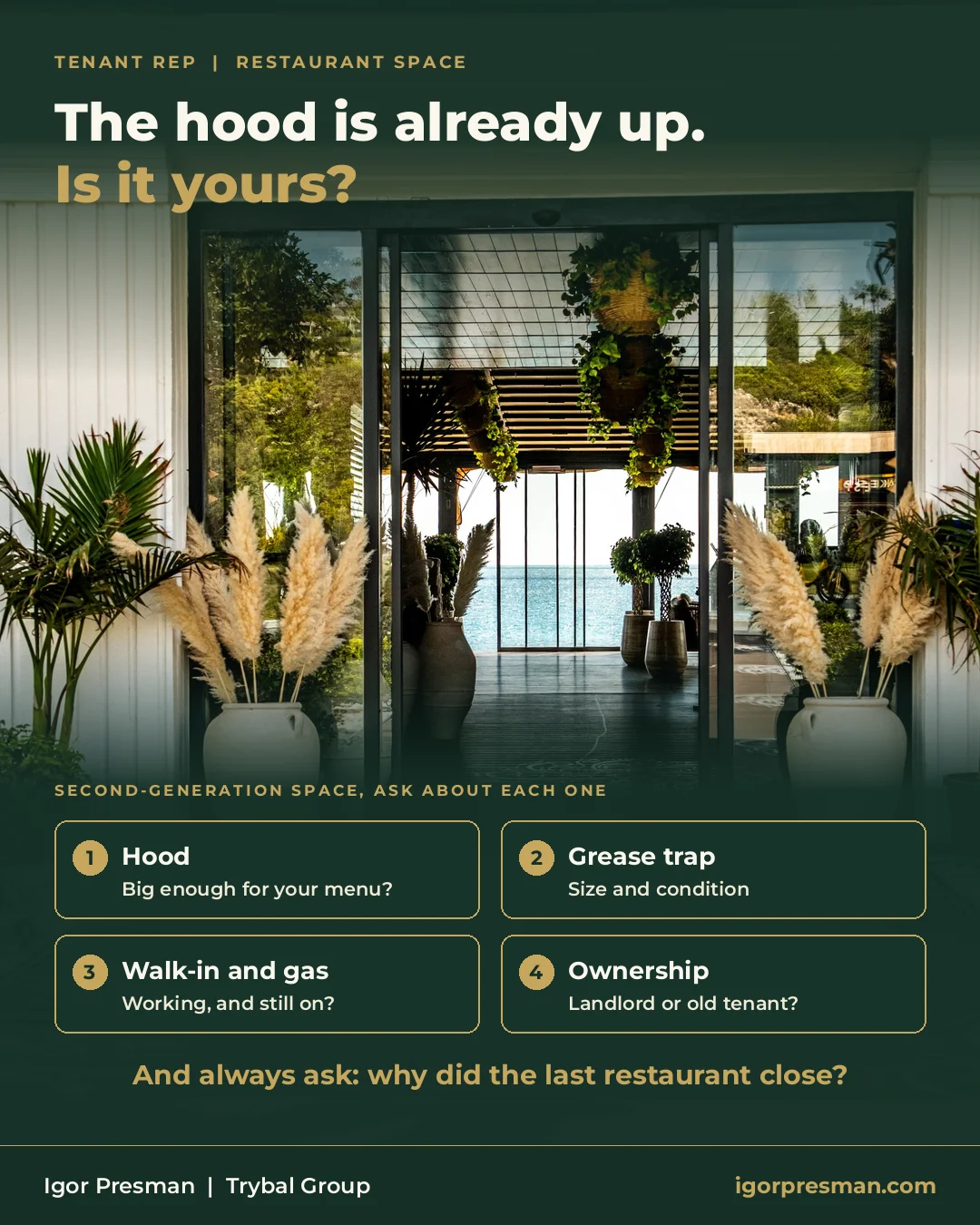
Short answer: a second-generation restaurant space is a space where a restaurant already operated. The hood is up, the grease trap is in the ground, and there may be a walk-in cooler in the back. Done right, that can save you months and a big part of the build-out budget. Done wrong, you inherit somebody else's problems. Before a client signs in Miami-Dade, Broward or Palm Beach, I walk the back of the house first. For the hood, the grease trap, the walk-in and the gas line, I ask three questions. Does it work today. Does it fit what you are going to cook. And who owns it. Then I check the electrical panel, whether the seats you want work with the parking and with what the city will approve, and why the last restaurant closed.
If you are opening a restaurant in South Florida, a second-generation space is usually the first thing you look for. Here is how I walk one with a client.
What is a second-generation restaurant space?
It just means a restaurant already operated there. You are not starting from a vanilla box. The kitchen infrastructure is already in place, or at least it looks like it is. That is the appeal. You can often open faster and spend less on build-out than you would in a space that has never had a kitchen.
The risk is that "already a restaurant" is not the same as "ready for your restaurant." The equipment may not work. It may not fit your menu. And it may not even stay with the space when you take it.
Start at the back of the house
The hood, the grease trap, the walk-in and the gas line are the expensive pieces. I start there, before we talk about the dining room or the rent.
The hood
Look at what it was built for, not just whether it is hanging over the line. A hood that was fine for a coffee and sandwich place may not be enough for a fry and grill menu. If your concept needs more cooking capacity than the last operator used, you may be looking at a new hood, not a wipe down and a start date.
The grease trap
Size and condition both matter. A trap that handled a lighter menu can be too small once you add frying, grilling or a heavier volume. Ask whether it is working today, when it was last serviced, and whether it is sized for what you plan to cook, not for what used to be cooked there.
The walk-in
Confirm that it cools, that it is the right size for your storage, and that it is staying. A walk-in that looks built in can still belong to the old tenant. If it does not work, or if it leaves with them, your opening budget changes fast.
The gas line
Find out whether gas service is still active or was shut off when the last restaurant left. If it is off, ask what it takes to turn it back on and whether the service is enough for your equipment. Do not plan a gas menu around a line you have not confirmed.
Who owns the equipment?
That last question surprises people. Sometimes the hood, the walk-in or other kitchen pieces stay with the landlord. Sometimes they still belong to the old tenant, or to someone that tenant owes money to. If you plan your opening around equipment that is going to be removed, or that a creditor can come claim, you find out at the worst time.
Get it in writing before you plan around it. The lease and a written inventory should say what stays, what goes, and who is responsible for it. A walkthrough photo is not enough.
Check the electrical panel
The panel is easy to skip because it is not as visible as a hood. Check it anyway. Your ovens, refrigeration, hood and point of sale all pull power, and a panel that worked for a lighter concept may not carry yours. If the panel has to be upgraded, that is time, cost and a permit, and it should be on the table before you sign, not after.
Seats, parking and what the city will approve
Then check the use, not just the space. The number of seats you want has to work with the parking at the plaza and with what the city will approve for a restaurant there.
A great kitchen does not help if the seating plan does not work. A dining room that looks big on the tour can shrink once parking and the city's approval are applied. I look at this in Miami-Dade, Broward and Palm Beach the same way: what you want to operate, what the center can support at your busy hours, and what the city will actually allow.
A space that was already a restaurant is not a free pass. You still need the approvals for your use and your seating. I wrote about that problem on the warehouse side in why a signed lease does not mean a tenant can open, and the same idea applies here. Confirm the use before you sign, not after.
The rest of the lease still matters too, including occupancy cost, exclusives and the terms at the end of the deal. I walk through that checklist in what a retail or restaurant brand should check before signing a lease.
Why did the last restaurant close?
Last, ask why the previous restaurant closed. Sometimes it was the operator, the concept or the price. Sometimes it was the location, the visibility or the parking. You want to know which one before you sign, because one of those you can fix and one you cannot.
If the last operator had a weak concept or ran the place poorly, a better operator can do well in the same box. If customers could not find it, could not park, or drove past without seeing it, those problems will still be there on your opening day. I would rather learn that on the tour than six months into a lease.
The space has to work for your customers
I spent about 30 years in retail before commercial real estate, and that is the part I pay the most attention to. The space has to work for your customers, not just look ready in the kitchen. The back of the house can look complete and still be wrong for your menu, your seats or your trade area.
If you want someone on your side of the table while you walk these spaces, I explain what a tenant rep does and who usually pays for it. And once you do sign, the work is not over. From first tour to opening day is usually a longer path than people expect.
FAQ
Q: What is a second-generation restaurant space?
A second-generation restaurant space is a space where a restaurant already operated. The hood, grease trap and often a walk-in and gas service are already there, which can save a new tenant time and build-out cost if those pieces work, fit the new menu and actually stay with the space.
Q: What should I check before leasing a second-generation restaurant space?
Start with the hood, the grease trap, the walk-in and the gas line. For each one, ask if it works, if it fits what you will cook, and who owns it. Then check the electrical panel, whether your seats work with the parking and with what the city will approve, and why the last restaurant closed.
Q: Who usually owns the hood, grease trap and walk-in?
It varies. Sometimes the equipment stays with the landlord. Sometimes it still belongs to the old tenant, or to someone they owe money to. Get a written list of what stays before you plan your opening around it.
Q: If the space was already a restaurant, do I still need city approval?
Yes. A prior restaurant use does not automatically approve your seats, your menu or your concept. The parking at the plaza and what the city will allow for a restaurant in that space still have to work for what you want to operate.
Q: Why does it matter why the last restaurant closed?
Because some problems leave with the old operator and some stay with the location. A weak concept or poor operations can be replaced. A visibility, access or parking problem will still be there when you open.
Opening a restaurant, cafe or franchise location in Miami-Dade, Broward or Palm Beach? Reach out through igorpresman.com or email sales@igorpresman.com, and we can walk the space together.

Igor Presman
Commercial Broker · Trybal Group
Have a deal this applies to?
Ask me directly — I answer every message personally, usually the same business day.