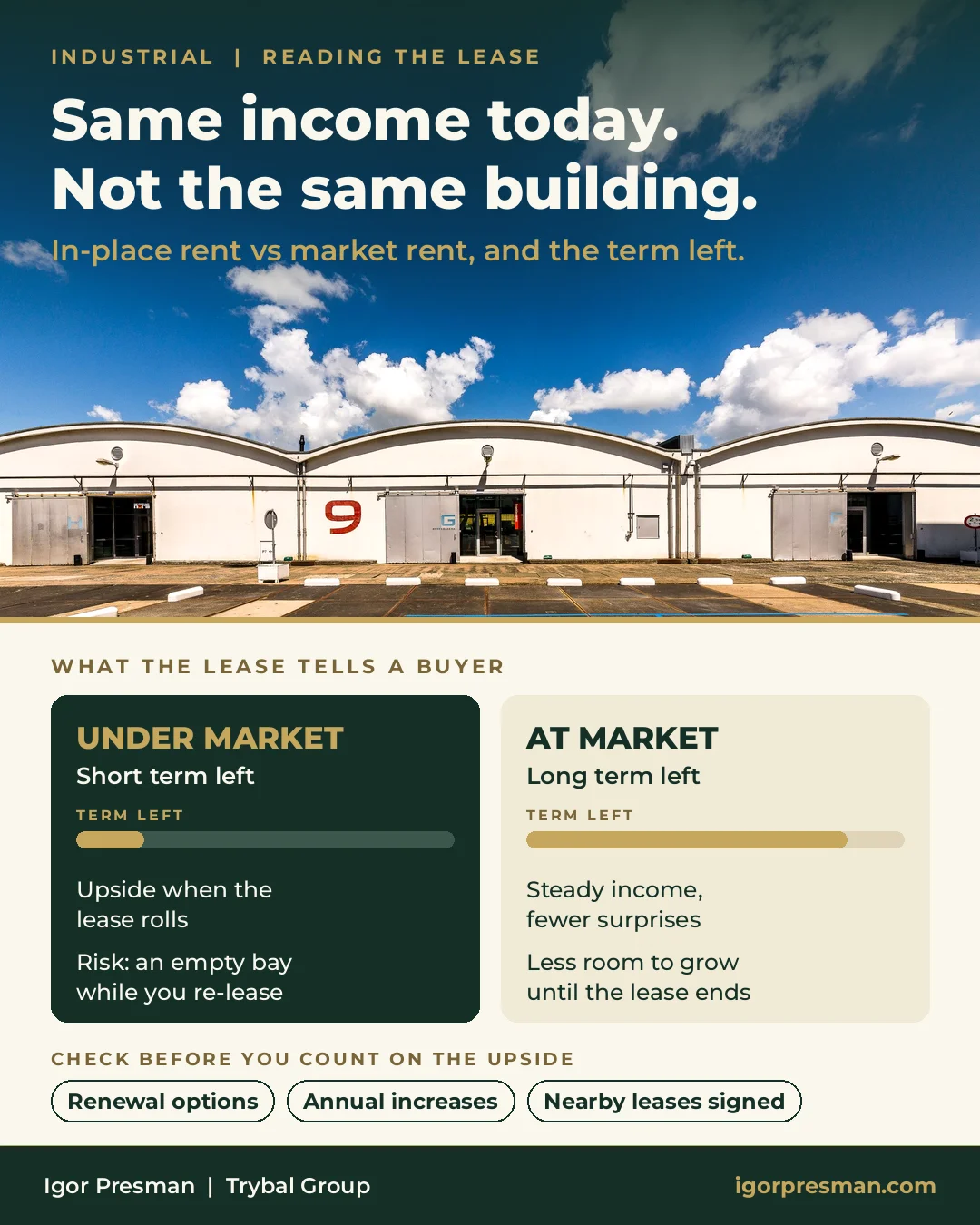
Short answer: in-place rent is what the tenant pays today, and market rent is what a similar space nearby would lease for right now. On an industrial building in Miami-Dade, Broward or Palm Beach, I look at those two numbers together with how much time is left on the lease. A tenant under market with a short term left is upside with turnover risk. A tenant at market with years left is steady income with less room to grow. Before anyone counts on the upside, I read the renewal options.
Two warehouses can show the same income today and still be worth very different money to a buyer. When I look at an industrial building with an investor, two lines in the lease get my attention before almost anything else: the rent compared to market, and the term left.
What is in-place rent and what is market rent?
In-place rent is the rent the tenant is paying right now under the current lease. Market rent is what a similar space in the same area would lease for if it came on the market today.
The two can drift apart over time. A lease signed years ago with small increases each year can end up well under market. A lease signed recently is usually close to market. Neither number tells you much on its own. The gap between them, and how long until the lease ends, is what matters.
Why term left changes the picture
The gap between in-place and market rent only matters when you can do something about it. That usually happens when the lease ends. A tenant paying under market with ten years left gives you very little to work with for a long time. The same tenant with one year left is a very different building.
That is why I read the rent and the term together, along with the full expiration picture. I go through how I look at expiration dates across a property in lease rollover risk and how I read a lease expiration schedule. The post is written around retail plazas, but the same thinking applies to a multi tenant warehouse.
Under market with a short term left
This is upside. When the lease ends, the rent can move closer to market, either with the same tenant on a renewal or with a new tenant.
The risk is the other side of the same coin. If the tenant leaves, the bay can sit empty while you carry the taxes, insurance and upkeep yourself until it is leased again. You may also need to put money into the space to get the next tenant in. A buyer who wants this kind of building should be ready for that.
At market with a long term left
This is steady income. Fewer surprises, a tenant that is likely to stay, and a rent that already reflects today's market. The tradeoff is less room to grow until the lease rolls. The annual increases in the lease are most of the growth you get.
Which one is better?
Neither one. It depends on the buyer. Some of my clients want the upside and are fine handling turnover and leasing. Others want a steady check and a tenant that stays put. The right building is the one that fits how you plan to own it.
What I check before anyone counts on the upside
- Renewal options. If the tenant has the right to renew at a fixed rent, or at a small bump, the upside may belong to the tenant, not to you. An option at fair market value is a different story.
- Annual increases. Small fixed increases over a long term are often how a lease drifts under market.
- What similar spaces nearby are actually leasing for, not just asking rents.
- How hard it would be for the tenant to move. A tenant that put real money into racking, power or office buildout has more reasons to renew.
- The paperwork. Every amendment, any option notice already sent, and the estoppel, so the rent and dates match what the seller told you.
- The tenant itself. Upside only helps if the tenant can keep paying until the lease ends. I cover that in what makes a warehouse tenant creditworthy.
For warehouse users: negotiate the renewal option on the way in
If you are a business leasing warehouse space in South Florida, flip all of this around. The things that look like upside to an investor are rent increases waiting to happen for you.
A renewal option is your protection. The time to ask for it is before you sign, when the landlord wants you in the building. A few points I push on for users:
- The right to renew at all, and for how many terms.
- How the renewal rent is set. A fixed rent or a set increase gives you certainty. Fair market value gives you less, so it helps to spell out how market is decided.
- The notice window. Know exactly when you have to tell the landlord you are renewing, and put it on the calendar. Missing the window can mean losing the option.
- What carries over. Make sure your improvements and any expansion rights do not disappear at renewal.
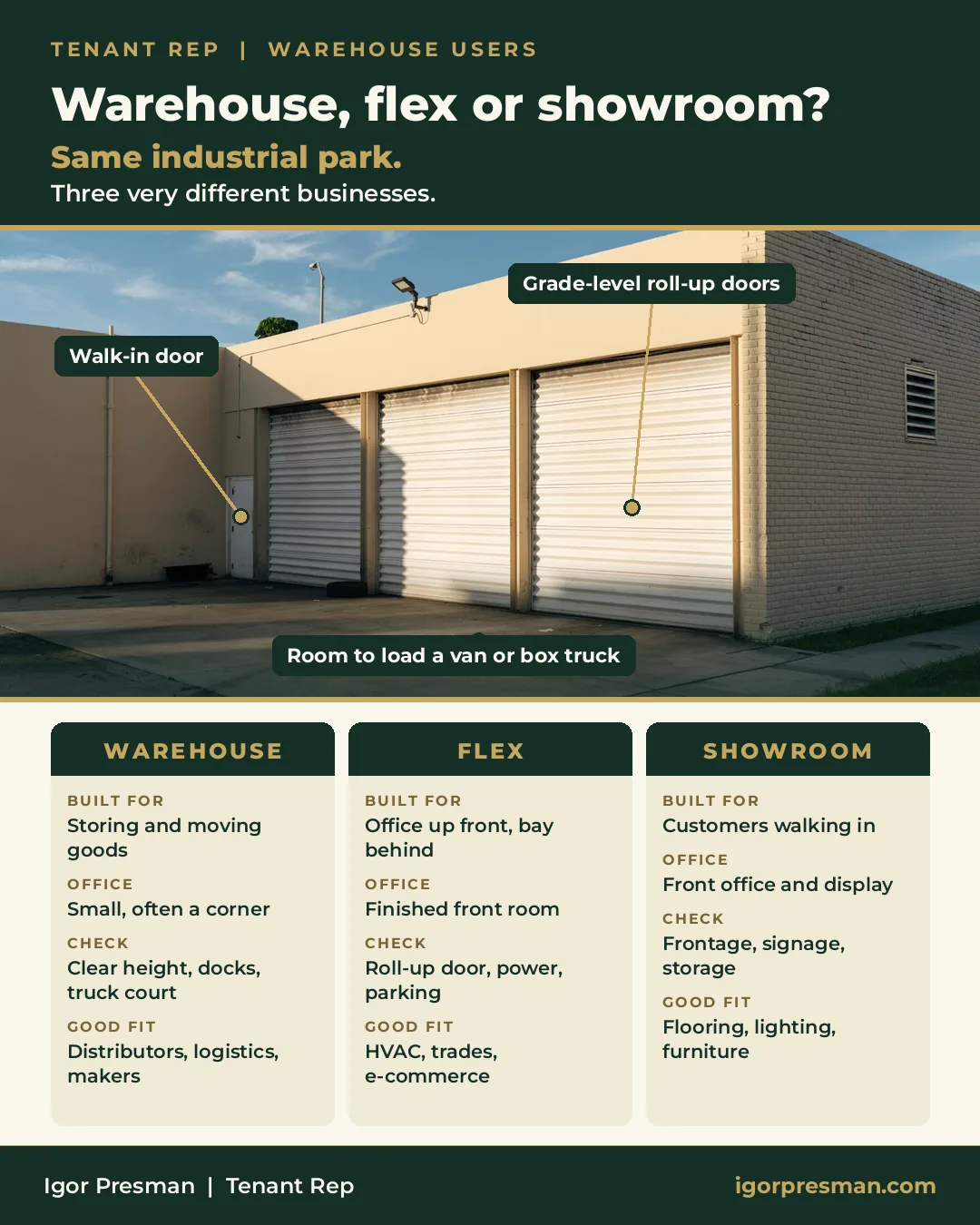
If you are still deciding what kind of space fits your business, start with warehouse vs flex vs showroom, and here is what I check on every warehouse tour in South Florida.
FAQ
Q: What is the difference between in-place rent and market rent?
In-place rent is what the tenant pays today under the current lease. Market rent is what a similar space nearby would lease for if it were available now. The gap between the two tells you whether a lease is under market, at market or above it.
Q: Is a warehouse with below market rent a good investment?
It can be, if the lease ends soon enough for the rent to move closer to market and the tenant does not have a renewal option at a fixed low rent. The risk is vacancy if the tenant leaves, along with the cost of carrying and re-leasing the space.
Q: How do renewal options affect the value of an industrial building?
A renewal option at a fixed rent or a small increase can keep the rent under market for years, which takes the upside away from the owner. An option at fair market value lets the rent reset closer to market at renewal.
Q: What should a warehouse tenant negotiate in a renewal option?
The number of renewal terms, how the renewal rent is set, the notice window to exercise the option, and whether improvements and expansion rights carry over. These are easiest to get before the lease is signed.
Q: Where do you work?
I work industrial, retail and multifamily across Miami-Dade, Broward and Palm Beach.
If you own or are looking at an industrial building in Miami-Dade, Broward or Palm Beach, or you are a warehouse user planning a lease, reach out and I will walk through the lease with you.

Igor Presman
Commercial Broker · Trybal Group