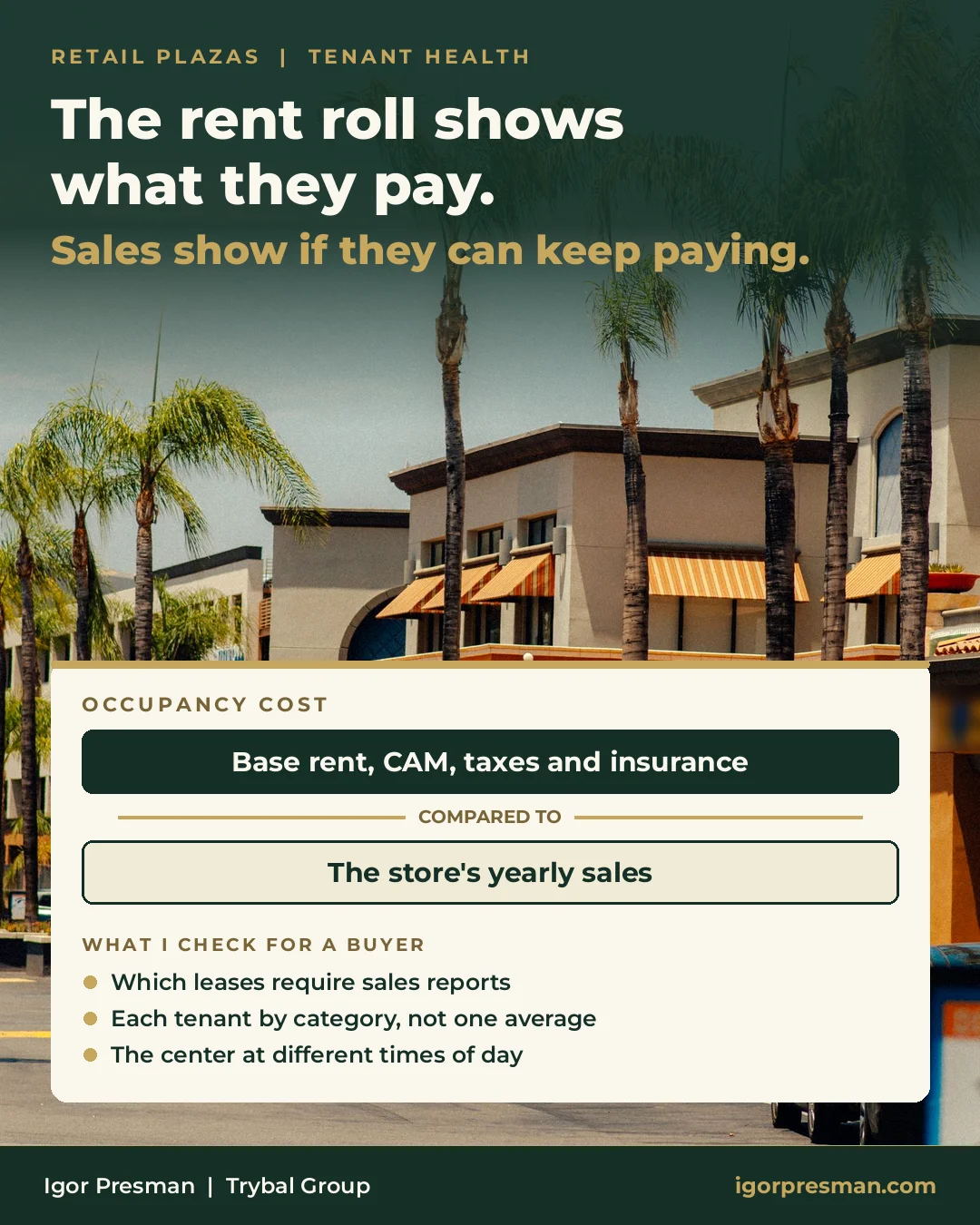
Short answer: occupancy cost is everything a tenant pays to be in the space, including base rent, CAM, property taxes and insurance, compared to what the store sells in a year. A rent roll tells you what each tenant pays. It does not tell you whether they can keep paying it. When I look at a plaza in Miami-Dade, Broward or Palm Beach, I check which leases require sales reports, ask the seller for any numbers they have, look at each tenant by category and walk the center at different times of day. Brands expanding into South Florida should run the same math before they sign.
A retail rent roll tells you what each tenant pays. For anyone buying a plaza, the more important question is whether they can keep paying it. That answer comes from occupancy cost.
What occupancy cost actually is
Occupancy cost is the full amount a tenant pays to occupy the space, set against that store's yearly sales. Base rent is only one piece. CAM, property taxes and insurance sit on top, and those line items can move even when the base rent looks steady.
I see this a lot in South Florida. A rent per foot can look reasonable on the flyer, then you add the charges and the picture changes, especially in a center where CAM and taxes have gone up. I walk through the common lease setups in NNN vs gross vs modified gross retail leases in South Florida.
When occupancy cost is a reasonable share of sales, the tenant has room to absorb increases, renew and sometimes expand. When it eats too much of the sales, the lease can look great on paper until the tenant asks for rent relief, stops paying, or leaves at the first option date. I cover those dates in lease rollover risk.
A simple example of the math
Here is a worked example so the math is clear. These are not real tenant numbers, and they are not a market average.
Say a store does $1,000,000 in sales in a year. Base rent is $60,000. CAM is $18,000. Property taxes are $12,000. Insurance is $6,000. Add those together and the occupancy cost is $96,000. Divide $96,000 by $1,000,000 and you get 9.6 percent. That is the occupancy cost ratio for this example.
Now keep the base rent the same and raise CAM and taxes by $15,000, with sales still at $1,000,000. The occupancy cost becomes $111,000, or 11.1 percent of sales. The rent roll still shows the same base rent. The load on the tenant is higher.
I am not using those percentages as a rule for what is safe or tight. Different uses can carry different loads, which is why I do not lean on one plaza-wide average.
How I look at occupancy cost when I review a plaza
When I look at a plaza for a buyer, I start with the leases.
First, I read them to see which tenants are required to report sales. Many smaller local tenants are not. Some leases include percentage rent above a set sales level, which means the landlord should already be getting sales numbers.
Second, I ask the seller for any sales reports they have, and I compare them to the rent roll and the CAM reconciliations. Missing reports are a question to ask, not a reason to assume the best.
Third, I look at each tenant by category. A restaurant, a salon, a medical office and a clothing store all run on very different numbers. One plaza average hides more than it shows.
Fourth, I walk the center at different times of day. Traffic, parking and which stores are busy tell you a lot about whose sales are real.
After about 30 years in retail, this is one of the first things I check when I walk a center.
Why a plaza average can hide a problem
A blended occupancy cost for the whole property can look fine while one or two tenants are stretched. Those are often the bays that create the next vacancy.
I would rather judge a restaurant against other restaurants, and a clothing store against its own sales, than flatten everything into one number. If sales look weak, I also want to know whether the problem is the concept or the center. A dark neighboring bay or a weak mix can starve a store that would do fine in a busier location.
The same math for brands expanding into South Florida
The same math works from the other side of the table. If you run a retail, restaurant or franchise brand expanding into Miami-Dade, Broward or Palm Beach, figure out what total occupancy cost your sales can carry before you fall in love with a location.
A space can look cheap on the flyer and still be the more expensive choice once you add CAM, taxes and insurance. A tenant rep can help you compare spaces on full cost, not just the base rent, and that work is usually paid from the landlord side.
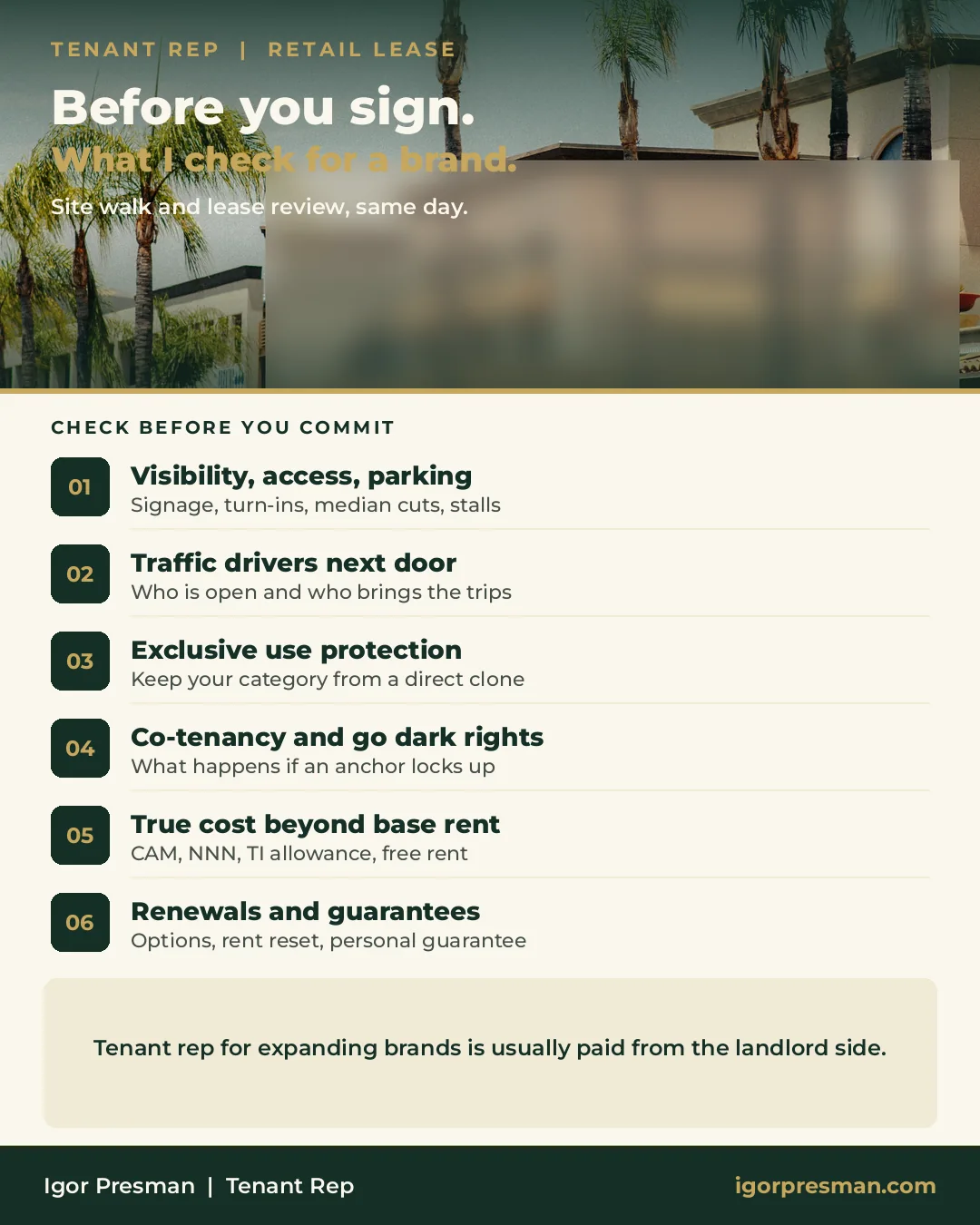
I cover the rest of the lease checks, including access, exclusives, co-tenancy and renewal terms, in what a retail or restaurant brand should check before signing a lease in South Florida.
FAQ
Q: What is occupancy cost in a retail lease?
Occupancy cost is everything a tenant pays to be in the space, including base rent, CAM, property taxes and insurance, not just the base rent on the rent roll.
Q: What is an occupancy cost ratio?
The occupancy cost ratio compares that full annual cost to the store's yearly sales. You add the rent and the charges, then divide by sales. I use it tenant by tenant, not as one number for the whole plaza.
Q: Why is the rent roll not enough when buying a retail plaza?
The rent roll shows what each tenant is paying. It does not show whether those payments are a reasonable share of sales, or whether rising CAM and taxes have already squeezed the tenant.
Q: What if a tenant is not required to report sales?
Many smaller local tenants are not required to report sales. I still ask the seller for any reports they have, compare them to the rent roll and the CAM reconciliations, and walk the center to see which stores are actually busy.
Q: Should a brand expanding into South Florida calculate occupancy cost before signing?
Yes. Run the full cost against the sales you can reasonably expect in that location before you sign. Compare more than one space on that basis, not on base rent alone.
I work with plaza buyers and with retail, restaurant and franchise brands across Miami-Dade, Broward and Palm Beach. If you are looking at a center or a space, reach out to me directly, browse my current listings, or ask about off-market opportunities.

Igor Presman
Commercial Broker · Trybal Group