Short answer: lease rollover risk is the chance that a big share of a retail plaza's rent ends in the same year. To see it, build a lease expiration schedule that lists every bay with its tenant type, size, rent per foot, how that rent compares to market, the lease end date and any renewal options. Then look for clusters, read the option language, and price in realistic downtime and leasing costs. A staggered schedule is usually healthier, and a short lease at a below market rent can be where the value is.
Every lease in a retail plaza ends at some point. The question for a buyer is which year, and how much of the rent leaves with it. When a client asks me to look at a plaza in Miami-Dade, Broward or Palm Beach, one of the first things I put together is a lease expiration schedule. It is a simple table, but it tells you more about the risk than the brochure does.
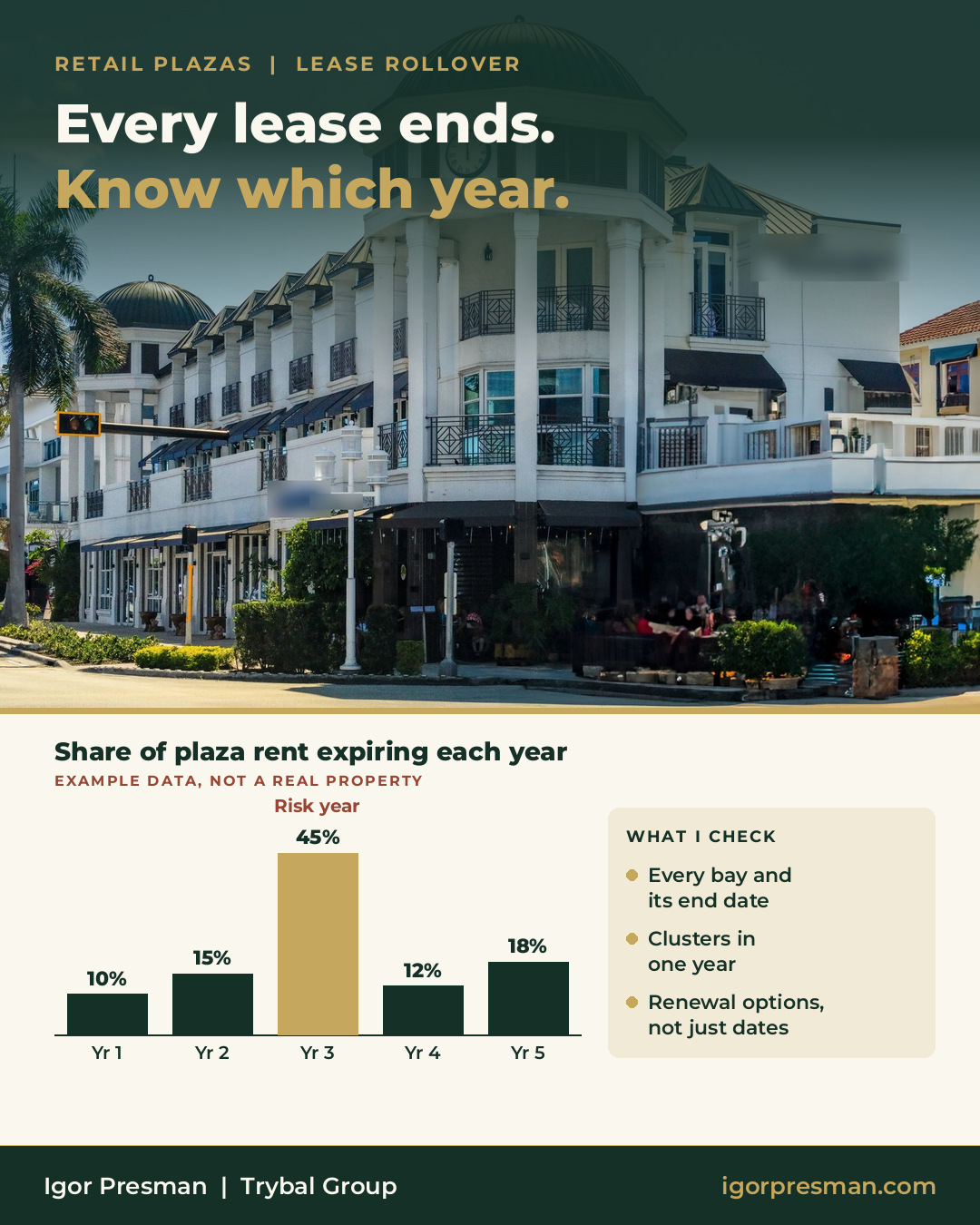
The chart in the image above uses example data to show what a clustered year looks like. It is not a real property.
What a lease expiration schedule is
A lease expiration schedule, sometimes called a rollover schedule, lays out when every lease in the building ends. For every bay I list:
- The tenant type
- The square footage
- The current rent per foot
- How that rent compares to market
- The lease end date
- Any renewal options, and how the option rent is set
Then I group it by year, so I can see how much of the building's rent and square footage comes due in each one.
Look for clustering first
The first thing I look for is clustering. If a big share of the rent comes due in the same year, that year is where the building's real risk sits.
Tenants know when you have several bays rolling at once, and they negotiate harder. If two or three of them leave together, you can be carrying vacancy, paying leasing commissions and funding tenant improvements all at the same time. Three leases ending in the same year can hurt a plaza more than one empty bay today.
Why a staggered schedule is usually healthier
When a few leases roll every year, you get steady chances to bring rents up to market without a big hit to income in any one year. Your leasing work is spread out, your tenant improvement spending is spread out, and no single year decides how the whole investment turns out.
Weighted average lease term and its limits
Some buyers also look at the weighted average lease term, often shortened to WALT. It is the average time left on the leases, weighted by rent or by square footage. It is a quick way to compare two plazas.
The problem is that an average can hide a cluster. Two plazas can show the same WALT, and one of them can have half its rent ending in a single year. So I use it as a first glance and still look at the schedule year by year.
Read the renewal option language
A renewal option is the tenant's right, not yours. The end date on the rent roll may not be the real end date if the tenant can extend.
I read exactly how the option rent is set. Is it a fixed rent, a set increase, or a reset to fair market? When is notice due? A long option at a fixed rent can keep a bay below market for years and lock you out of the upside. An option tied to market rent is a very different thing.
A short lease is not always bad
A short lease is not automatically a problem. If the rent is well under market, the rollover can be where the value is. That is often how a buyer adds value to a plaza without changing anything else.
It just has to be priced in. I want realistic downtime for a vacant bay, realistic leasing commissions, and a realistic budget for tenant improvements, not a best case where every tenant renews at a higher rent the day their lease ends.
Round it out before closing
Before closing, the estoppels confirm what each tenant says about their lease, including option rights. I cover those in tenant estoppel certificates. A conversation about which tenants have already asked about renewing fills in the rest of the picture.
If the plaza has an anchor, its lease end date and any co-tenancy clauses deserve their own look, which I walk through in what happens to a retail plaza when the anchor leaves. Lease structure matters too, so see NNN vs gross vs modified gross leases.
FAQ
Q: What is lease rollover risk?
Lease rollover risk is the chance that a large share of a property's rent ends at the same time, leaving the owner with vacancy, leasing costs and tenant improvements in the same year.
Q: What is a lease expiration schedule?
A lease expiration schedule lists every lease in a property with its size, rent, end date and renewal options, grouped by year so you can see how much rent comes due each year.
Q: What is WALT in commercial real estate?
WALT stands for weighted average lease term. It is the average time left on the leases, weighted by rent or square footage. It is useful for quick comparisons but can hide a cluster of expirations.
Q: Are renewal options good for the landlord?
Not always. A renewal option is the tenant's right. A long option at a fixed rent can keep a space below market for years, while an option reset to market rent is usually better for the owner.
Q: Is a short lease bad when buying a retail plaza?
Not necessarily. If the rent is well under market, the rollover can be an opportunity, as long as downtime and leasing costs are priced in.
I work with retail plaza buyers across Miami-Dade, Broward and Palm Beach. If you are looking at a plaza and want a second set of eyes on the rent roll and the lease dates, reach out to me directly, browse my current listings, or ask about off-market opportunities.

Igor Presman
Commercial Broker · Trybal Group