Short answer: an outparcel, also called a pad site, is the small building out by the road in front of a shopping center, often on its own separate parcel. Pads get the best visibility, their own curb cut and room for a drive-thru, so national tenants often pay more per foot for them. Before you buy a plaza, find out who owns each pad, whether it is leased or on a ground lease, how many years are left, and what the reciprocal easement agreement, or REA, allows.
Next time you pull into a plaza, look at the small building out by the road. The bank, the coffee drive-thru, the urgent care, the fast food place with the line of cars wrapped around it. A lot of the time, that building sits on its own separate parcel, apart from the shopping center behind it. For anyone buying retail in Miami-Dade, Broward or Palm Beach, it is one of the first things I look at.
What an outparcel or pad site is
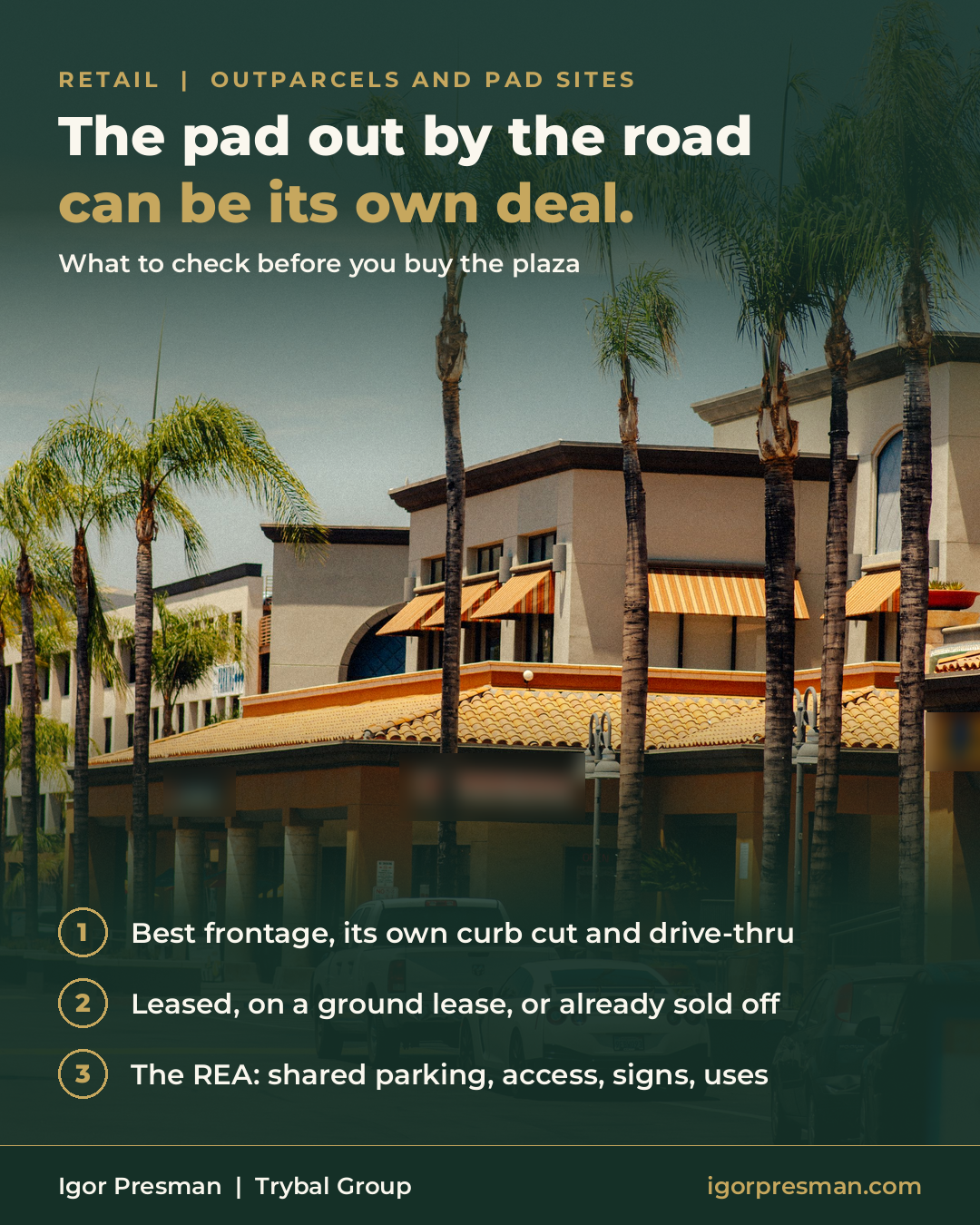
An outparcel is a piece of land at the edge of a shopping center, usually along the main road, with its own freestanding building. People use outparcel and pad site to mean the same thing. It may share parking and driveways with the plaza, but on paper it is often its own parcel with its own owner, its own lease and sometimes its own tax bill.
Why tenants want pad sites
Tenants love pads for simple reasons.
- They sit closest to traffic, so they get the best visibility.
- They usually have their own curb cut, so drivers can get in and out fast.
- They have room for a drive-thru lane.
- They get their own sign and parking right at the door.
That is why national tenants will often pay more per foot for a pad than for a bay inside the plaza. Banks, coffee, quick service restaurants and medical users all compete for the same spots.
Three ways a pad can be held
A pad can be held in one of three ways, and each one changes what you are buying.
Option one: the plaza owner leases the building
The plaza owner keeps the pad and leases the building to a tenant, like any other space in the center. The rent shows up on the rent roll, and the owner is responsible for the building under whatever the lease says.
Option two: a ground lease
The tenant builds its own building and pays rent for the land only, usually on a long term. Ground leases can be very steady income, because the tenant has its own money in the building. When the lease ends, what happens to the building depends on what the lease says, so you have to read it. I check the remaining term, the renewal options and the rent increases.
Option three: split off and sold
The pad was split off and sold. Then someone else owns it, and it is not part of your deal at all, even if it looks like part of the plaza when you drive by.
The first question I ask: are the pads included?
That last case is why the first question I ask when a client looks at a plaza is simple. Are the pads included in the sale, or were they sold off years ago?
If they are gone, you are buying the center without its best frontage. If they are still included, they can sometimes be worth more on their own than as part of the plaza. Some owners sell them separately later, or put a ground lease on an empty pad. An empty pad with good access can be real upside, as long as the documents allow it.
Read the reciprocal easement agreement (REA)
The second thing I read is the reciprocal easement agreement, usually called the REA. It ties the plaza and the pads together. It typically covers:
- Shared parking and driveways.
- Who pays to maintain the common areas.
- Sign rights.
- Height limits, so a pad does not block the view of the stores behind it.
- Use restrictions, like a clause that keeps a second grocery or a competing restaurant off the pad.
A pad can look like free money until you find out the REA blocks the use you had in mind, or the city needs those parking spaces to stay put. Tenant leases inside the plaza can also carry their own restrictions on what goes on the pads, so I read those alongside the REA.
What I check before a client buys a plaza with pads
So before buying, I want to know:
- Who owns each pad.
- How each pad is leased, and whether it is a building lease or a ground lease.
- How many years are left on any ground lease, and what happens to the building at the end.
- What the REA allows, and what tenant leases in the plaza restrict.
- Whether the parking count still works if a pad is built or changed.
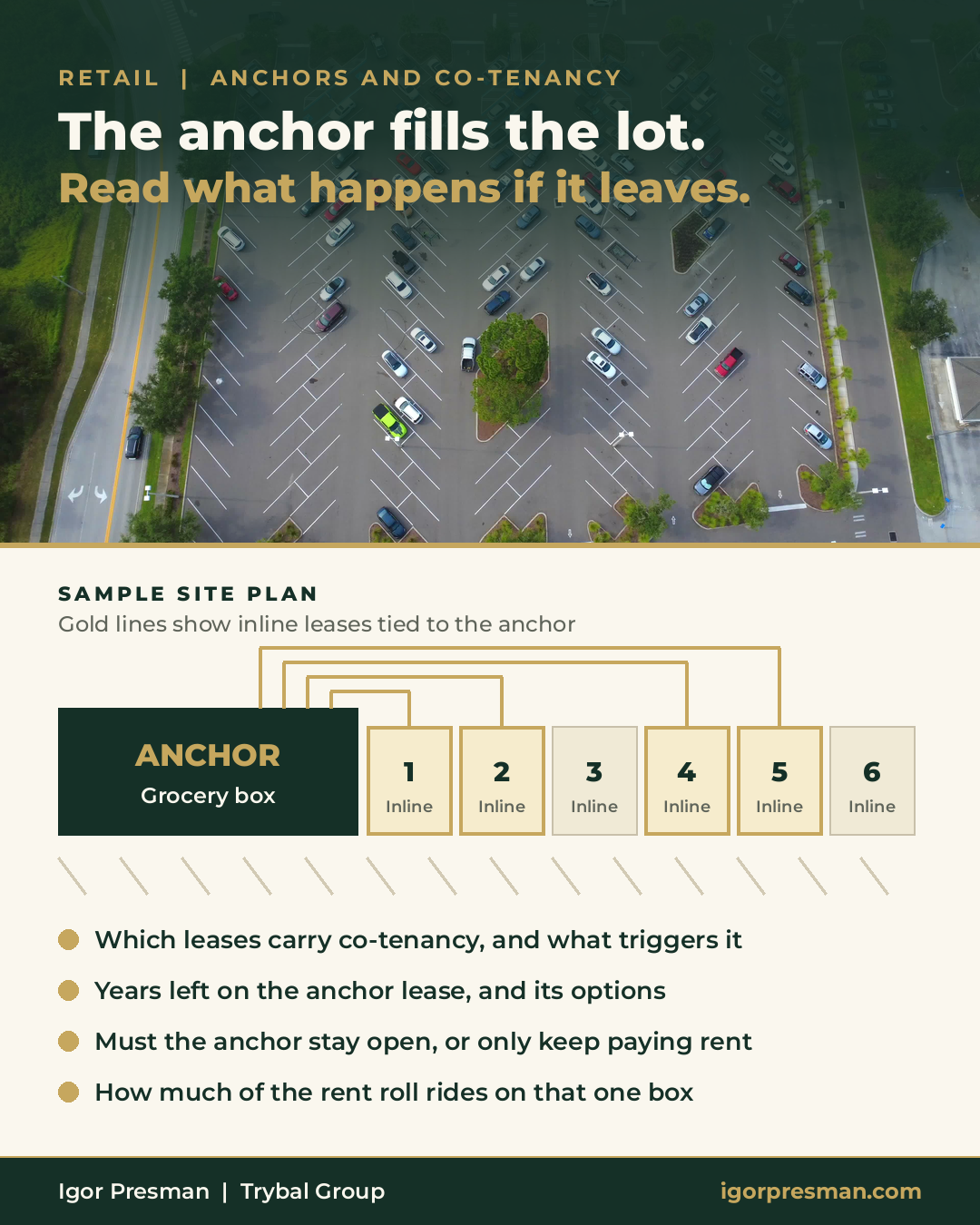
That is how you know what you are really buying. Lease structure matters too, which I cover in NNN vs gross vs modified gross retail leases. If the plaza has an anchor, read what happens to a retail plaza when the anchor leaves. And for the bigger picture, see why South Florida retail is one of the tightest markets in the country.
FAQ
Q: What is an outparcel in a shopping center?
An outparcel is a separate piece of land at the edge of a shopping center, usually along the main road, with its own freestanding building such as a bank, coffee drive-thru or restaurant.
Q: Is a pad site the same as an outparcel?
Yes. Pad site and outparcel are used to mean the same thing.
Q: What is a ground lease on a pad site?
On a ground lease, the tenant builds its own building and pays rent for the land only, usually on a long term. What happens to the building when the lease ends depends on the lease.
Q: What is a reciprocal easement agreement?
A reciprocal easement agreement, or REA, ties a plaza and its pads together. It covers shared parking and driveways, common area maintenance, sign rights, height limits and use restrictions.
Q: Are outparcels always included when you buy a plaza?
No. Pads are often split off and sold separately, so always confirm which parcels are part of the sale.
I work on retail plazas across Miami-Dade, Broward and Palm Beach. If you own one with pads, or you are thinking about buying one, reach out to me directly, browse my current listings, or ask about off-market opportunities.

Igor Presman
Commercial Broker · Trybal Group